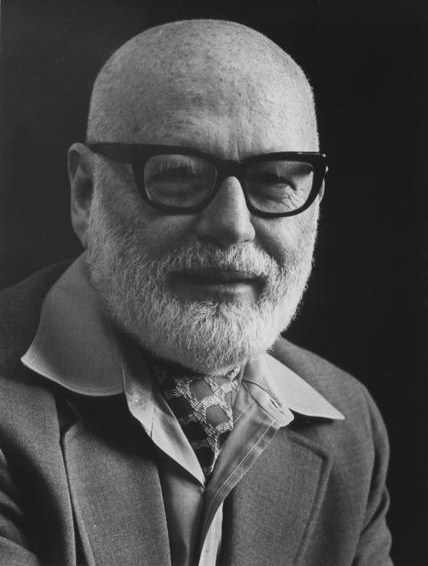
About Thomas A. Sebeok
Born in Budapest, Hungary, on Nov. 9, 1920, Sebeok left Hungary in 1936 to study at Magdelene College, Cambridge University. The following year, he immigrated to the United States and became a citizen in 1944. He earned a bachelor's degree at the University of Chicago in 1941 and a master's degree in 1943 and doctorate in 1945 at Princeton University. While at Princeton, he commuted to Columbia to pursue his studies of linguistics under the tutelage of Roman Jakobson, his doctoral dissertation director. He maintained a lifelong attachment to the University of Chicago, which awarded him a Professional Achievement Citation in 1992.
He came to IU in 1943 to assist in running the largest Army Specialized Training Program in foreign languages in the country and eventually took over the helm. He was assigned to teach courses in the Department of English, but later went on to create IU's renowned Department of Uralic and Altaic Studies. He was offered the directorship of the Research Center for Anthropology, Folklore, and Linguistics. Several fellowships at the Stanford University Center for Advanced Studies in the Behavioral Sciences gave him the opportunity to return to his avocation, biology.
A new scholarly field was born, biosemiotics. As his new academic base transformed itself into the Research Center for Language and Semiotic Studies in 1956, Sebeok, then a Distinguished Professor in Linguistics, established programs in semiotics and came to share with his friend and colleague, Umberto Eco, the signal honor of holding a designated chair of semiotics. In 1991, he was awarded the title of Distinguished Professor Emeritus of Anthropology, of Linguistics, of Semiotics, and of Central Eurasian Studies.
A linguist studying Finno-Ugric languages, his linguistic fieldwork took him to Central and Eastern Europe, including Lapland and the former Soviet Union. He also carried out studies in the former Mongolian People's Republic, Mexico and in the U.S. (among the Winnebago Indians of Wisconsin and the Laguna Indians of New Mexico). In addition to these studies in grammar and phonology, his interest in anthropology, folklore and literary studies led to early publications dealing with folksongs, charms, games, poems and the supernatural. He carried out some of the first computer analyses of verbal texts and published a path-breaking volume on MYTHIN (1955), and STYLE IN LANGUAGE (1960). At the same time, he contributed to the creation of the new field of psycholinguistics, publishing, with Charles Osgood, the famous classic text, PSYCHOLINGUISTICS (1954).
By 1960, he had established himself as a scholar known for overcoming academic boundaries between subjects in his own research, in collaborations with scholars in adjacent fields, and in organizational roles as a book and journal editor, founder and officer of several academic organizations, conference organizer, and mentor. In the 1960s, he turned to the study of human nonverbal and animal communication, publishing several seminal volumes on these topics that made important contributions to the comparative study of communication and signification. The publication of his classic APPROACHES TO SEMIOTICS (1964), marked the beginning of his turn toward general semiotics (the study of signs and symbols).
His book, SPEAKING OF APES (1980), presents a detailed critical evaluation of current investigations of the ability of apes to learn language. The transmission of information among animals was also the subject of HOW ANIMALS COMMUNICATE (1977), a volume which Sebeok edited. He also wrote PORTRAITS OF LINGUISTS (1976), a book dealing with the history of Western linguists from the late 18th century to the present.
Sebeok was the recipient of five honorary doctorates -- three from European institutions, one from a U.S. university and another from a university in Argentina. He was a member of the Hungarian Academy of Sciences and retained affiliations with other three universities until his death: the Institute for Advanced Study (Collegium Budapest), the University of Helsinki and the University of Toronto. He also had been a visiting professor at the universities of Michigan, New Mexico, Arizona, Illinois, Colorado, South Florida and Stanford, as well as Puerto Rico, Vienna, Besancon, Hamburg and Bucharest. Well-known as a forceful and stimulating teacher and speaker, over the years he held visiting appointments at 33 universities in 17 countries. He was awarded fellowships for advanced study at the Center for Advanced Study in the Behavioral Sciences, East-West Center [Hawaii], Netherlands Institute for Advanced Study, National Humanities Center, Smithsonian Institution, Woodrow Wilson International Center for Scholars, XXXInstitute for Advanced Study and Fundatia Culturala RomanaFundatia Culturala Romana. In 1971, he was awarded a medal by the College de France in Paris for "appreciation of your uncommon contributions to French culture." In 1972, he accepted a commission from UNESCO to prepare a worldwide study of university teaching of linguistics.
Throughout his career, Sebeok contributed to and edited numerous scholarly publications, including Semiotica (journal of the International Association of Semiotic Studies), The Journal of American Folklore, Encyclopedic Dictionary of Semiotics, The Semiotic Web (Yearbook of Semiotics), numerous IU-based publications in Uralic and Altaic Series and Semiotics and Toronto Studies in Semiotics. Among his many honors, he received the Distinguished Service Award of the American Anthropological Association, IU's President's Medal of Excellence, Honorary Membership in the Hungarian Academy of Sciences and Domus Hungarica Scientiarum (Artium Prize) from the Hungarian Academy of Sciences.
Thomas A. Sebeok, a pioneer in the field of semiotics and Distinguished Professor emeritus of linguistics and semiotics at Indiana University, died at his home on December 21, 2001.